

How Sewage Pumping Stations Work
I. Three Core Components of Sewage Pumping Stations
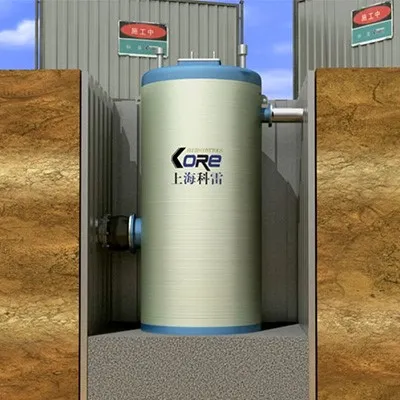
Integrated sewage pumping stations are like "underground sewage delivery stations" in cities, with three core parts working in seamless coordination:
Sump Well: Acts as a collection warehouse, filtering large debris such as plastic bags through grilles.
Submersible Sewage Pump: Serves as the "delivery courier," featuring a non-clog impeller design to handle fiber-containing sewage.
Control System: Functions as an intelligent dispatch center, automatically starting and stopping pumps based on water level changes.
II. Intelligent Logic of Sewage Transportation
The entire workflow is equipped with smart designs:
Water Level Monitoring: Ultrasonic sensors detect water level fluctuations in real time.
Graded Startup: Single pump operates at low water levels, while dual pumps work in linkage at high water levels for enhanced efficiency.
Anti-Silting Design: The funnel-shaped bottom of the cylinder prevents sludge accumulation.
Backwashing Function: Automatically flushes the pump body when shut down to avoid impurity adhesion.
III. Hidden Eco-Friendly & Energy-Saving Designs
These details make the pumping station both efficient and environmentally friendly:
Adopts frequency conversion technology, reducing power consumption by 40% compared to traditional pumping stations.
Fully sealed structure ensures zero odor leakage.
Noise level is controlled below 55 decibels for quiet operation.
Corrosion-resistant FRP material extends the service life to up to 20 years.
